

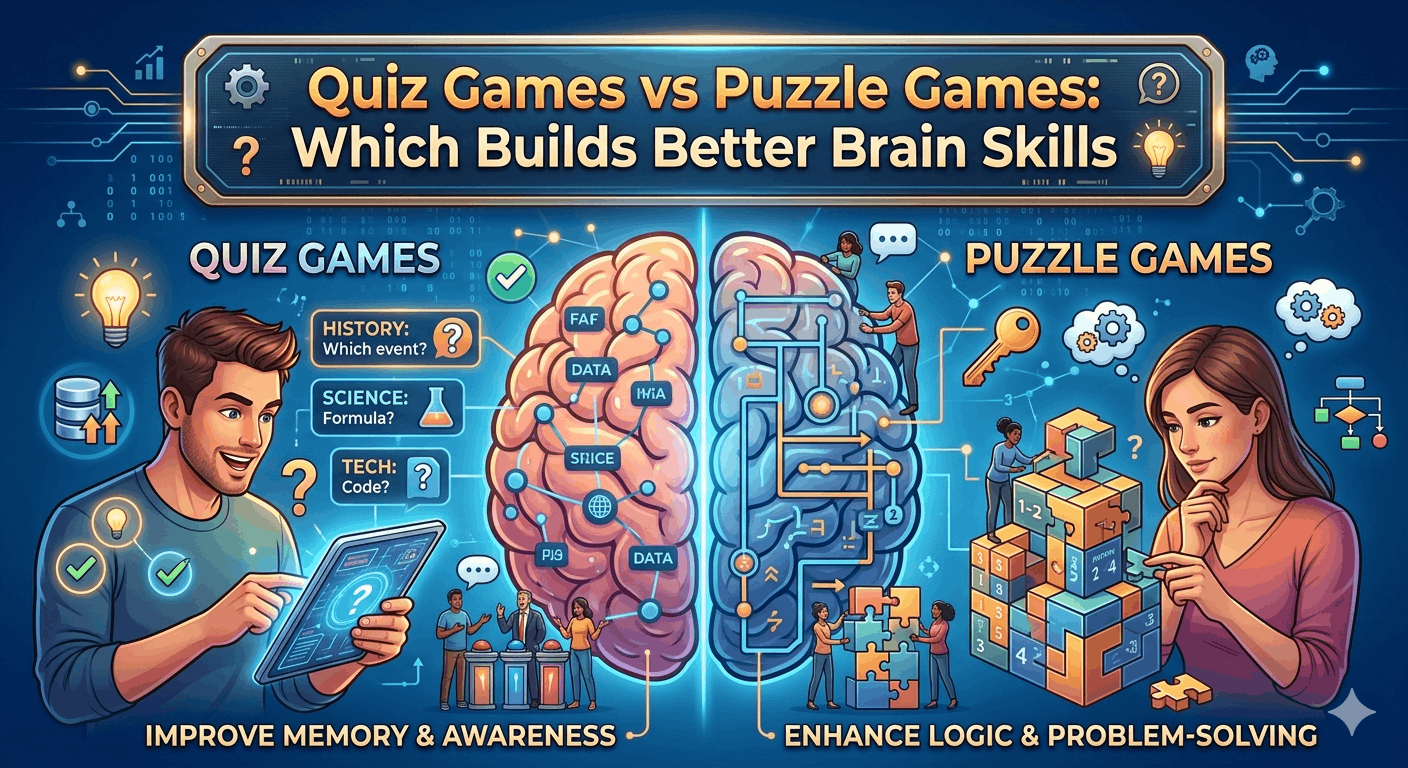
In today’s digital world, brain games are more popular than ever. From quick quiz questions to tricky puzzles, people play these games not just for fun but also to keep their minds sharp.
But this raises an important question: which type of game is actually better for your brain: quiz games or puzzle games?
The answer is not as simple as choosing one over the other. Both types of games train the brain in different ways. Understanding how each works can help you decide which suits your learning and thinking style better.
How quiz games sharpen memory and awareness
Quiz games are all about recalling information quickly. They test your knowledge across topics like history, science, current affairs, and pop culture. When you play quiz games regularly, your brain gets used to retrieving stored information faster.
This improves memory recall and strengthens your ability to connect facts. It also boosts general awareness, especially when quizzes include current events and trending topics. Over time, you start remembering details more clearly and for longer periods.
Another important benefit is speed. Quiz games help your brain think quickly, especially when you are under pressure. This skill is not just useful in games, but also in real life, like during exams, job interviews, or when making quick decisions.
How puzzle games improve logic and problem-solving
Puzzle games focus more on thinking than remembering. They challenge you to solve problems using logic, patterns, and strategy. Whether it is a number puzzle, word game, or visual challenge, these games push your brain to think deeper.
Playing puzzle games regularly improves analytical skills. You learn how to break down complex problems into smaller steps. This builds patience and helps you approach challenges in a structured way.
Puzzle games also improve concentration. Since many puzzles require sustained focus, they train your brain to stay attentive for longer periods. This can help improve productivity in daily tasks.
Memory vs logic: The core difference
| Aspect | Quiz Games | Puzzle Games |
| Core focus | Memory-based learning | Logic and problem-solving |
| Skill type | Recall and recognition | Analysis and reasoning |
| Knowledge requirement | Depends on existing knowledge | Does not require prior knowledge |
| Brain function used | Memory retrieval | Critical thinking and logical processing |
| Key benefit | Improves general knowledge and awareness | Enhances problem-solving and thinking skills |
| Best for | Learning facts and staying updated | Developing reasoning and analytical skills |
| Ideal goal | Boost knowledge and confidence | Improve logic and critical thinking |
Which game type improves overall brain function?
Both quiz and puzzle games contribute to brain development, but in different ways. Quiz games activate the brain’s memory centres, while puzzle games engage problem-solving areas.
Interestingly, studies suggest that using both types of games together creates a balanced cognitive workout. When you combine memory-based learning with logical thinking, your brain becomes more flexible and adaptive.
This balance is important in real life. Most situations require both knowledge and reasoning. For example, making a smart decision often involves recalling information and analysing it at the same time.
The role of consistency in brain training

No matter which type of game you choose, consistency matters more than anything else. Playing occasionally may be fun, but regular practice is what brings real benefits.
Daily quiz challenges can slowly improve your awareness. In the same way, solving puzzles regularly can make your thinking sharper. Even if you spend just 10 to 15 minutes a day, you can start to see a difference.
The main idea is to keep your brain active. You can also switch between quiz and puzzle games so you don’t get bored and your learning stays interesting.
Choosing the right game for your goal
Your choice between quiz and puzzle games should depend on what you want to improve.
If you enjoy learning new facts and testing your knowledge, quiz games are a great fit. They are also ideal for students and competitive exam preparation.
If you prefer challenges that involve thinking and problem-solving, puzzle games will suit you better. They are perfect for improving logic and mental clarity.
For the best results, try combining both. This way, you train different parts of your brain and build a well-rounded skill set.
Conclusion
In the end, both quiz games and puzzle games play an important role in building strong brain skills. Quiz games help you stay informed and improve your memory, while puzzle games train your mind to think logically and solve problems. Instead of choosing one, combining both can give you a more balanced and effective mental workout.
If you are looking for a fun and engaging way to boost your knowledge daily, Qureka Gamez is a great option. It gives you fun quiz challenges on different topics, so you can learn new things while having a good time. By playing regularly, you can improve your thinking, stay updated, and make learning a simple daily habit.