

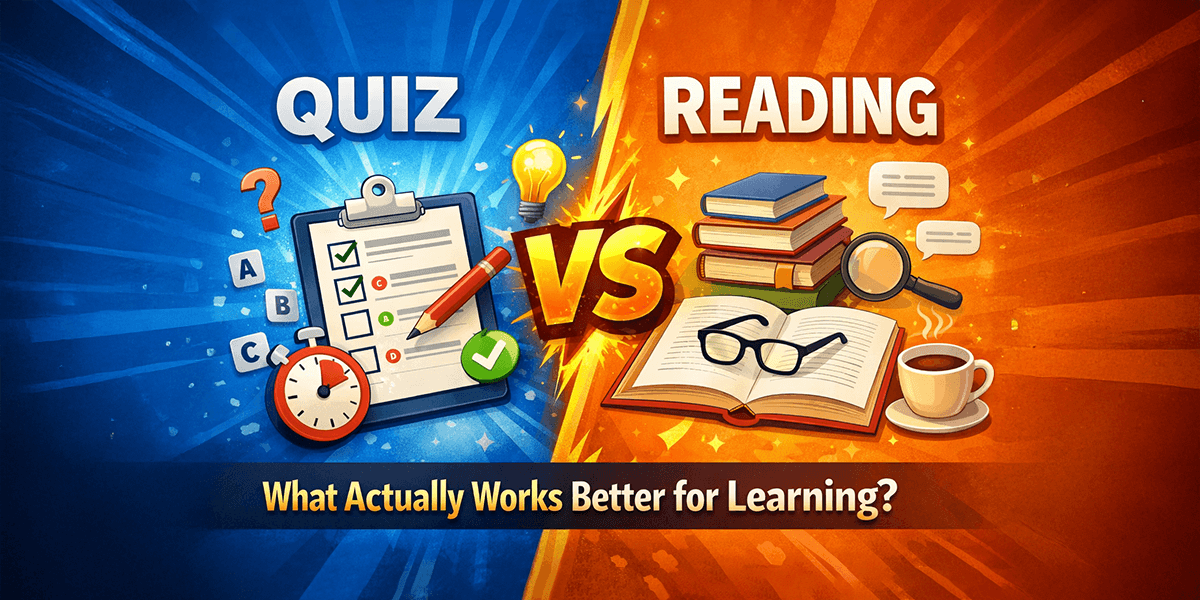
Learning today looks very different from how it used to be. People are no longer limited to books for gaining knowledge, but now they have switched to interactive tools like quizzes, which have become just as popular as traditional reading. Both options offer real value, but they have different purposes. Knowing how each one helps can make it easier to choose what works best for you.
Let’s understand both of them in depth to gain clarity about them.
Understanding reading as a learning method
Reading has been a core learning method for centuries. Books, articles, magazines, guides, etc provide detailed information on almost any topic. This method allows deep exploration of concepts, ideas, and theories.
Reading builds strong comprehension skills. It helps you understand context, logic, and structure. You can move at your own pace and revisit complex sections anytime. It also improves vocabulary and critical thinking over time.
However, reading can sometimes feel passive. Without active engagement, it becomes easy to forget what you read. Long texts may also reduce attention span, especially in a fast-paced digital environment.
Understanding quizzes as a learning method
Quizzes are often considered a more interactive way to learn. They test your knowledge through questions, challenges, and instant feedback. This method turns learning into an active process.
Quizzes improve memory retention. When you recall information to answer questions, your brain strengthens those connections. This process is known as active recall. It helps you remember concepts for a longer time.
They also add an element of fun and competition. Timed quizzes and score-based systems motivate users to perform better. This makes learning feel less like a task and more like a game.
However, quizzes often focus on short information. They may not provide detailed explanations unless they are well-designed. Without proper context, it will be less understandable.
Key differences between the quiz and the reading
The main difference lies in how information is consumed. Reading focuses on input, while quizzes focus on output.
Reading delivers knowledge, while quizzes test how much you remember.
Reading is ideal for building foundational understanding, as it explains concepts in depth and connects ideas logically, whereas Quizzes, on the other hand, reinforce what you have already learned.
Another key difference is engagement level. Reading requires focus and patience, whereas Quizzes demand quick thinking and active participation. This makes quizzes more engaging for short learning sessions.
Which method improves memory better?
Quizzes have a strong advantage when it comes to memory. Active recall plays a major role in long-term retention. When you answer questions, your brain works harder to retrieve information.
Reading alone may not offer the same level of retention as quizzes do. Without revision or testing, information fades quickly. This is why many learners forget what they read after a short time.
However, reading still plays an important role. It provides the knowledge that quizzes later reinforce. Without reading or learning content, quizzes lose their purpose.
When to choose reading?

Reading is the best choice when you want to understand a new topic. It helps you to explore details, examples, and explanations. If you are studying complex subjects, reading is essential for it.
It is also useful for research and professional learning. Detailed materials help you to build expertise and gain deeper insights.
When to choose quizzes?
Quizzes work best for revision and practice. They help you test your understanding and identify weak areas. If you want to improve your memory and speed, quizzes are highly effective for this purpose.
They are also ideal for quick learning sessions. You can learn in short bursts without investing too much time.
The best approach is a combination
Choosing between a quiz and reading is not about picking one over the other. The most effective learning strategy combines both methods. One should start by reading to understand the topic. Then use quizzes to test and reinforce your knowledge.
This combination creates a balanced learning cycle. Reading builds knowledge, and quizzes strengthen memory. Together, they improve both understanding and retention.
Final thoughts
In the end, the choice between quizzes and reading depends on how you learn best. Reading helps you build strong concepts and understand topics in depth, while quizzes reinforce that knowledge and improve retention. Instead of choosing one over the other, combining both creates a more effective and balanced learning experience.
If you enjoy learning through interactive methods, platforms like Qureka Gamez can make the process more engaging. It offers fun quiz-based challenges where you can test your knowledge while earning rewards. Using such apps alongside regular reading can make learning both productive and enjoyable at the same time.