

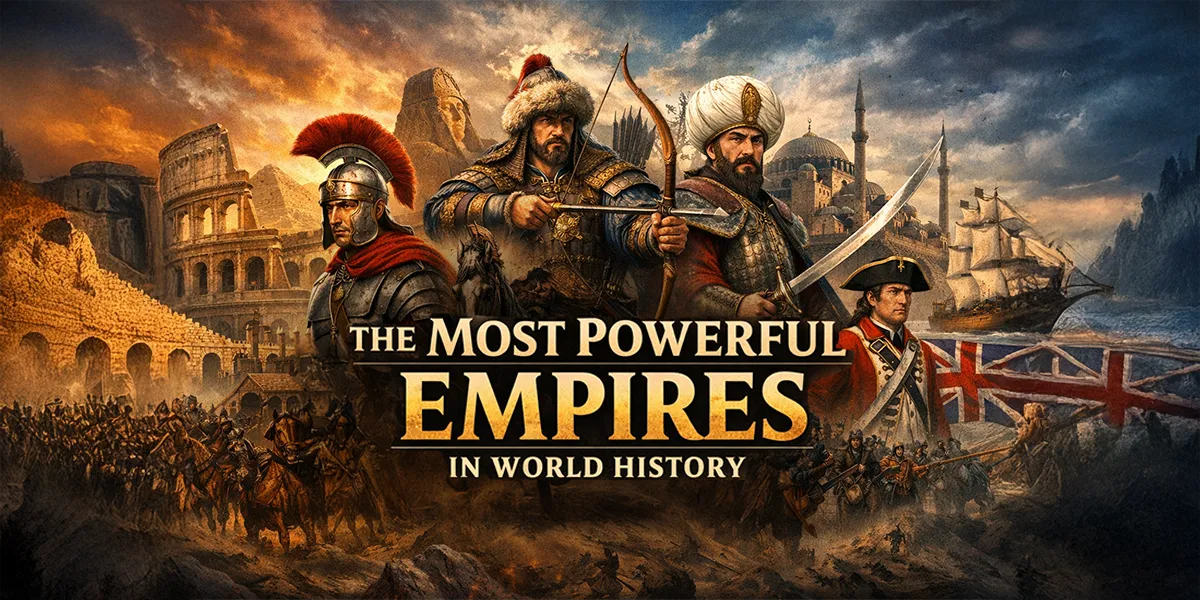
“All empires fall, but the ideas they spread can last forever.”
Throughout history, powerful empires have shaped the world’s political, cultural, and economic development. These empires expanded their territories, controlled important trade routes, and spread languages, religions, and ideas across continents.
The famous historian Will Durant once wrote, “Civilisation is a stream with banks… The stream is sometimes filled with blood from people killing and fighting, but the banks are built by thinkers, artists, and leaders who shape civilisation.”
His words remind us that empires were not only about wars and conquests, they also helped build systems, cultures, and institutions that influenced future generations.
Today, learning about such empires is easier and more engaging through quiz platforms and learning apps like Qureka Gamez, where users can test their general knowledge through fun trivia and history-based questions.
Five Powerful Empires That Once Ruled the World
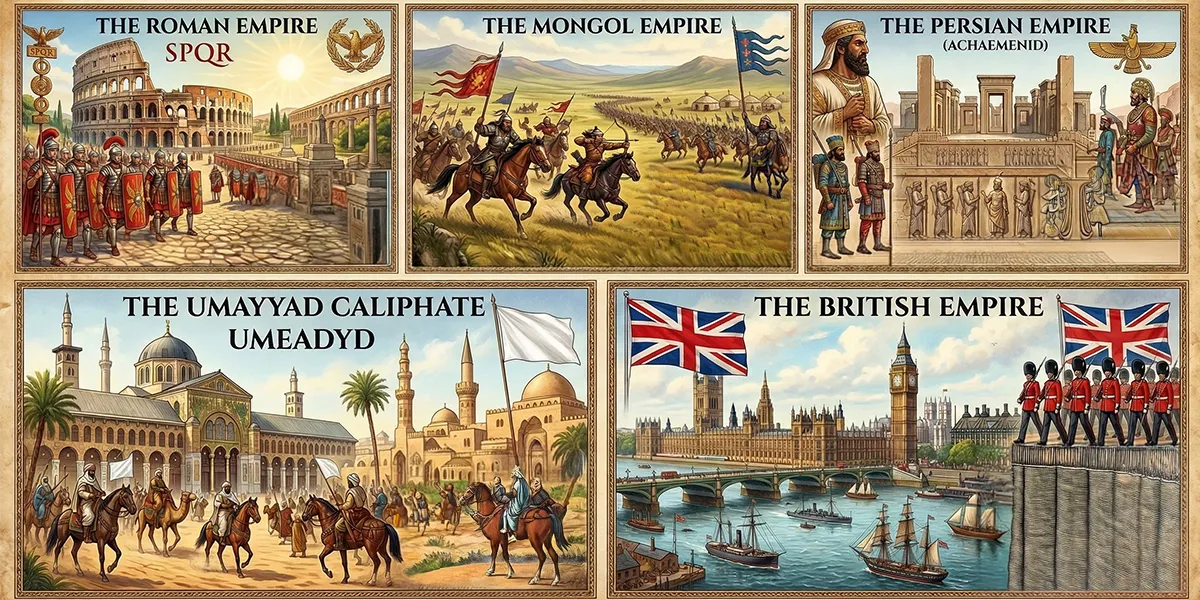
1. The British Empire
The British Empire is widely considered the largest empire in world history. At its peak in the early 20th century, it ruled nearly one-quarter of the world’s land area and population. Its territories stretched across Asia, Africa, North America, and Oceania, including India, Canada, Australia, and many African nations.
Britain became so powerful mainly because of its strong navy and global trade network. It also benefited greatly from the Industrial Revolution, which gave it technological and economic advantages over other countries.
A famous phrase often associated with this empire is “The sun never sets on the British Empire.” Because Britain had colonies across many time zones, the sun was always shining somewhere in its territories.
Historian John Robert Seeley once commented on Britain’s expansion, saying, “We seem, as it were, to have conquered and populated half the world in a fit of absence of mind.”
2. The Mongol Empire
The Mongol Empire, founded by Genghis Khan in 1206, became the largest contiguous land empire in history. Within a few decades, Mongol warriors conquered vast territories stretching from the Pacific Ocean to Eastern Europe.

The Mongol army was famous for its speed and clever battle strategies. Their highly mobile cavalry units allowed them to travel long distances quickly and defeat much larger armies.
Although the Mongols were known for their fierce conquests, they also helped connect the world through trade. They protected the Silk Road trade routes, making it easier for merchants, travellers, and scholars to move between Asia and Europe.
Historian Jack Weatherford described their influence by saying, “The Mongols made the world smaller.” Their empire helped connect distant cultures and economies in ways never before seen.
Many history quizzes ask about Genghis Khan and the Mongol Empire because of their massive influence on global history. Platforms like Qureka Gamez include such fascinating historical trivia, making learning about empires both fun and rewarding.
3. The Roman Empire
The Roman Empire is one of the most influential empires in world history. Starting in 27 BCE, it expanded across Europe, North Africa, and parts of the Middle East. At its height under Emperor Trajan, Rome controlled vast territories and millions of people.
Rome was not only powerful in warfare but also brilliant in engineering and administration. Roman engineers built thousands of kilometres of roads, bridges, and aqueducts that connected cities and supported trade and travel.
The famous saying “All roads lead to Rome” reflects the vast road network that connected the empire.
The Roman statesman Cicero once said, “The sinews of war are infinite money.” His words highlighted the essential role of wealth and resources in maintaining military power.
4. The Persian Empire
The Persian Empire, founded by Cyrus the Great in the 6th century BCE, was one of the earliest large empires in world history. At its height, it stretched from Greece and Egypt in the west to Central Asia and parts of India in the east.
One of the reasons for its success was its innovative governance system. The empire was divided into provinces known as satrapies, each ruled by a governor who reported to the king. This system helped manage the empire’s vast and diverse territories.
Cyrus the Great was also famous for his fairness and tolerance toward different cultures and religions. Because of this, many historians consider him one of the most respected rulers of the ancient world.
Greek historian Herodotus once praised the Persian communication system, writing:
“Neither snow nor rain nor heat nor gloom of night stays these couriers from the swift completion of their appointed rounds.”
Historical topics like the Persian Empire are commonly included in general knowledge quizzes. Learning such facts through quiz platforms like Qureka Gamez makes history more interactive and memorable.
5. The Umayyad Caliphate
The Umayyad Caliphate became one of the largest empires of the early medieval world. It expanded rapidly from the Middle East across North Africa and into Spain and Central Asia.
This empire played a major role in spreading Islam and building centres of culture and learning. Cities such as Damascus and Cordoba became famous for their libraries, scholars, and trade networks.
One dramatic story from this period involves the Muslim commander Tariq ibn Ziyad during the conquest of Spain in 711 CE. According to legend, after landing with his army, he ordered the ships burned so the soldiers would have no option but to move forward and fight.
Conclusion
The rise and fall of powerful empires has shaped the course of human history. The British, Mongol, Roman, Persian, and Umayyad empires ruled vast territories and influenced millions of people. Some dominated through military strength, while others succeeded because of effective governance, trade networks, or cultural influence.
Even though these empires eventually declined, their legacy continues to influence the modern world. Many languages, political systems, and cultural traditions today can be traced back to these powerful civilisations.
For those who enjoy exploring such fascinating historical topics, quiz platforms like Qureka Gamez provide an engaging way to test knowledge, learn surprising facts, and discover more about the empires that shaped our world.
Frequently Asked Questions
1. Which was the largest empire in world history?
The British Empire was the largest empire in history, ruling nearly one-quarter of the world’s land and population at its peak.
2. Who founded the Mongol Empire?
The Mongol Empire was founded by Genghis Khan in 1206.
3. Why was the Roman Empire so powerful?
The Roman Empire became powerful due to its strong military, advanced engineering, and efficient governance.
4. Who founded the Persian Empire?
The Persian Empire was founded by Cyrus the Great in the 6th century BCE.
5. Which empire spread Islam across large regions?
The Umayyad Caliphate expanded Islam across the Middle East, North Africa, and parts of Europe.