

“The roads that connected the ancient world were not just routes for goods, but pathways for ideas, beliefs, and cultures.” — Peter Frankopan
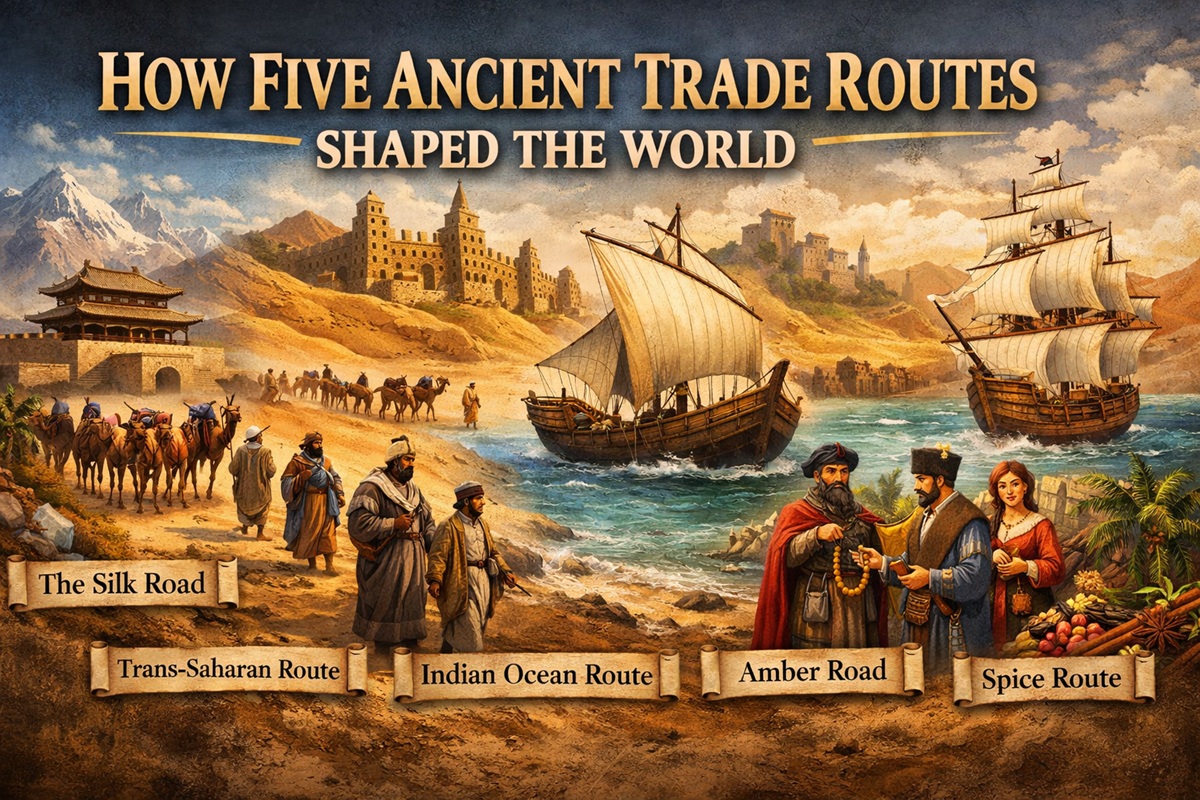
Long before modern borders and transport systems, trade routes connected distant parts of the world. These routes were not just about buying and selling goods; they helped spread ideas, cultures, and traditions across continents.
Traders carried more than products; they carried knowledge and beliefs that shaped societies. As Marco Polo suggested, these journeys were so rich and surprising that they were hard to fully describe.
These ancient routes laid the foundation for the connected, globalised world we see today.
Five Ancient Trade Routes
1. Silk Road
The Silk Road remains the most iconic trade network in history, stretching from China to the Mediterranean. It was not a single road but a vast web of interconnected paths.
Through this network, traders exchanged silk, spices, ceramics, and precious metals, while also facilitating the spread of religions such as Buddhism and the transfer of technologies like papermaking.
These exchanges transformed isolated civilizations into interconnected societies, making the Silk Road one of the earliest examples of globalisation.
2. Indian Ocean Trade Route
Unlike land-based routes, the Indian Ocean Trade Route relied on maritime navigation, connecting East Africa, Arabia, India, and Southeast Asia.

Traders exchanged goods such as spices, textiles, ivory, and gold, while port cities flourished as centres of commerce and cultural interaction. The use of monsoon winds made travel efficient and predictable, strengthening long-distance trade networks.
This route not only boosted economic ties but also created multicultural coastal societies that blended African, Arab, and Asian influences.
As Ibn Battuta observed, “Travelling—it leaves you speechless, then turns you into a storyteller,” capturing the richness of cultural encounters along these routes.
3. Trans-Saharan Trade Route
Crossing the harsh Sahara Desert, the Trans-Saharan Trade Route connected West Africa with North Africa and the Mediterranean world.
Camel caravans transported valuable goods such as gold and salt, generating immense wealth and supporting the rise of powerful empires, such as Mali. Alongside material trade, Islam spread across the region, influencing education, governance, and culture.
This led to the emergence of cities like Timbuktu as centres of learning and scholarship. The route played a crucial role in integrating Africa into global trade networks, as exemplified by Mansa Musa, whose wealth and influence highlighted Africa’s global significance.
4. Amber Road
The Amber Road linked the Baltic region with Southern Europe, enabling the trade of amber, a highly prized natural resin used in jewellery and ornamentation.
This exchange not only facilitated economic connections between northern and southern Europe but also encouraged the movement of artistic styles, cultural practices, and ideas.
Over time, the route contributed to early forms of economic integration within Europe, fostering a sense of shared cultural identity.
5. Spice Route
The Spice Route connected Asia with the Middle East and Europe, driven by the high demand for spices such as pepper, cinnamon, cloves, and nutmeg.
These goods were not only used for flavour but also for preservation and medicinal purposes, making them extremely valuable.
The immense profitability of the spice trade encouraged exploration and competition among European powers. This ultimately led to the Age of Exploration, reshaping global trade networks and political dynamics.
The Bigger Picture
These trade routes did far more than transport goods; they connected civilizations, spread religions, encouraged innovation, and built multicultural societies.
They laid the foundation for modern global trade and cultural exchange. As Adam Smith wisely stated, “The division of labour is limited by the extent of the market,” and these ancient routes expanded markets in ways that continue to shape our world. If you enjoy discovering such fascinating facts, platforms like Qureka Gamez make learning fun by turning knowledge into engaging quizzes and challenges.
People Also Ask
1. Which was the most important trade route in history?
The Silk Road is considered the most significant due to its vast cultural and economic impact.
2. How did trade routes influence culture?
They enabled the exchange of languages, religions, food, and traditions across regions.
3. Why were spices so valuable?
Spices were used for food preservation, medicine, and flavour, making them highly demanded.
4. Are these trade routes still relevant today?
While not used in the same way, their legacy continues in modern global trade systems.