

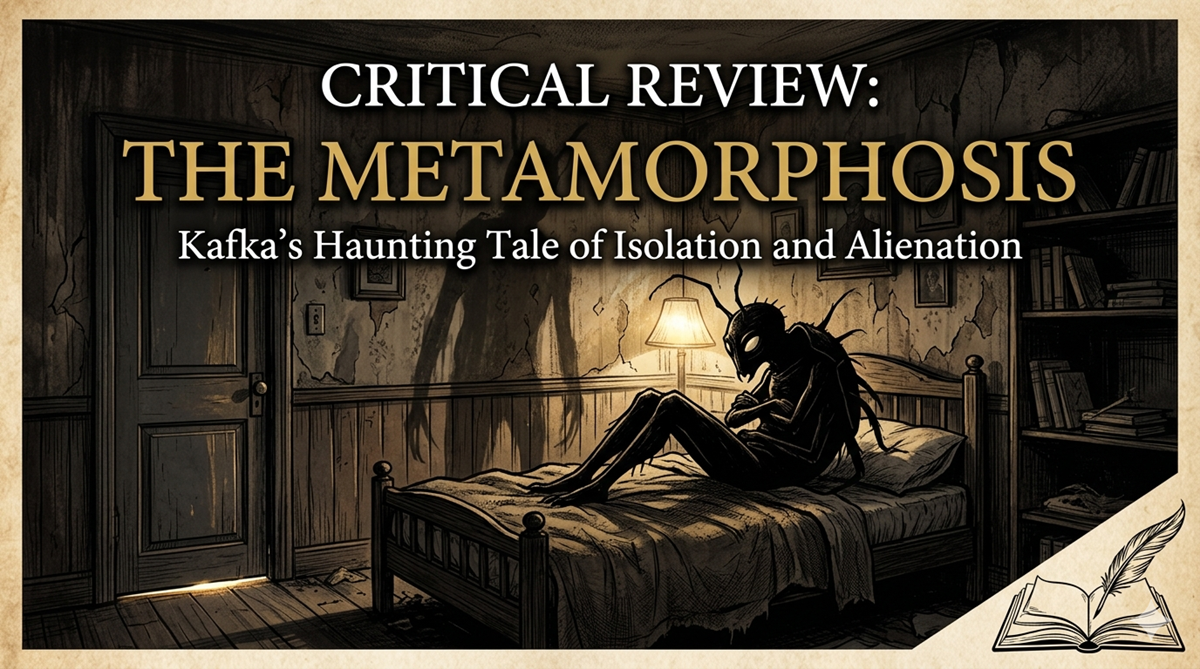
Very few books unsettle, provoke, and stay with readers as much as The Metamorphosis by Franz Kafka. Published in 1915, this novella remains one of the most famous works on alienation, identity, and the delicate nature of human relationships. Kafka doesn’t just tell a story; he creates an experience that is both emotionally intense and deeply meaningful.
The Metamorphosis starts with one of the strangest and most memorable openings in literature. Gregor Samsa, a regular travelling salesman, wakes up one morning and discovers he has turned into a giant insect. What stands out is not just how strange this is, but also the calm and matter-of-fact way it is described.
This story is less about how the transformation happens and more about what it shows us. Kafka puts the reader in an uncomfortable position, making us face the disturbing reality of Gregor’s new life. It is not just a fantasy, but a twisted reflection of real human experience.
Summary: A Simple Overview of the Story
The Metamorphosis by Franz Kafka tells the story of Gregor Samsa, a travelling salesman who wakes up one morning to find himself mysteriously transformed into a giant insect. Shocked but still thinking about his daily responsibilities, Gregor tries to adjust to his new condition while worrying about his job and his family.
As Gregor struggles to communicate and move, his family reacts with fear and confusion. At first, his sister Grete takes care of him by bringing food and keeping his room clean. However, as time passes, the family’s patience begins to fade. Gregor is no longer able to work, and the financial burden shifts to the rest of the family.
Gradually, Gregor becomes isolated in his room. His presence becomes an embarrassment and a source of stress for the family. Grete, who was once kind and supportive, starts to see him as a problem. His parents, too, become distant and harsh.
In the end, Gregor grows weak and dies alone. After his death, the family feels a sense of relief and begins to move on with their lives, looking forward to a better future without him.
Analysis: Themes of Alienation and Dehumanisation
Kafka’s talent is in turning a strange event into something that feels emotionally real. At its core, The Metamorphosis is about alienation. Gregor’s situation is a metaphor for the modern person, trapped in roles, misunderstood, and seen as replaceable.
A key theme in the story is how people can lose their humanity when they are valued only for what they do. Before his change, Gregor mattered to his family because he brought in money. When he can’t work anymore, his value drops quickly. This is a sharp criticism of a society that judges people by their productivity.
Another strong theme is how easily family ties can break. Kafka challenges the idea of unconditional love by showing how quickly caring can turn into resentment when things get tough. Gregor’s family doesn’t turn away from him right away, but their slow withdrawal makes the story even sadder.
Kafka’s writing style adds to these themes. His words are clear and almost cold, which stands out against the story’s strong emotions. This distance creates a strange feeling, making readers feel both connected to and separated from Gregor’s pain.
Evaluation: A Masterpiece of Psychological Depth
The Metamorphosis is not an easy book to read, and it is not supposed to be. Its power comes from how uncomfortable it makes us feel. Kafka makes readers face questions they might prefer to ignore:
- What defines our humanity?
- Are we valued for who we are or what we provide?
- How fragile is our place in the world?
One of the novella’s biggest strengths is how universal it feels. Even though the story is strange, the feelings it brings up, like loneliness, rejection, and helplessness, are very human.
Still, some readers might find the story unsettling or even sad. The ending is unresolved, and the mood is dark, which can be hard to take. But these parts are important to Kafka’s message. The story does not comfort us, just as real life often does not.
Conclusion

The Metamorphosis is more than a story; it is a mirror held up to society and the self. Kafka’s portrayal of Gregor Samsa forces us to examine our own relationships, values, and fears. It is a work that demands introspection and rewards it with profound insight.
If you are looking for a light, entertaining read, this may not be the book for you. But if you are willing to engage with a text that challenges and disturbs in equal measure, The Metamorphosis is an essential literary experience.
And if exploring such thought-provoking questions excites your mind, why stop at books? Platforms like Qureka Gamez offer a fun and interactive way to test your knowledge, challenge your thinking, and engage with intriguing questions across a wide range of topics. After all, just like Kafka’s work, the joy often lies in exploring the unexpected.