

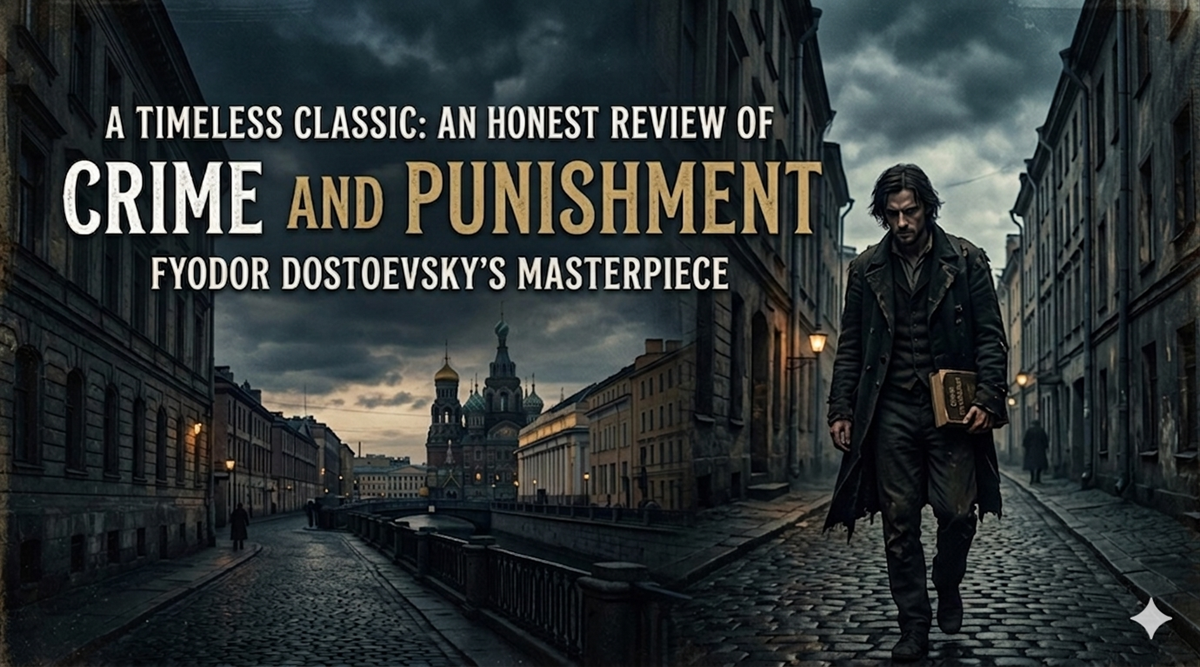
Few novels in world literature capture the intricate workings of the human mind like Fyodor Dostoevsky’s Crime and Punishment. First published in 1866, this Russian masterpiece delves deep into morality, conscience, and the psychological torment that follows a morally transgressive act. For readers seeking more than just a story, this novel offers a profound exploration of human nature, societal pressures, and the eternal struggle between right and wrong.
A Plot that Challenges Your Morality
At its core, Crime and Punishment follows the story of Rodion Raskolnikov, a former law student living in St. Petersburg, who commits a shocking act: he murders a pawnbroker. But the crime is just the beginning. What makes the novel truly compelling is Dostoevsky’s unflinching examination of Raskolnikov’s internal struggle. The reader is pulled into his mind, experiencing his fear, guilt, and rationalisations. It is both thrilling and disturbing to witness a person wrestle with conscience as they try to justify actions that defy moral law.
Unlike typical thrillers, the suspense in Crime and Punishment isn’t built solely on the crime itself but on the ethical and psychological tension. As Raskolnikov navigates interactions with law enforcement, his family, and other morally complex characters, the novel forces readers to question: what drives a person to cross ethical boundaries? And can redemption truly be earned?
Rich, Complex Characters
Dostoevsky’s genius is not only in the plot but in his characters, each intricately drawn and morally nuanced. Raskolnikov is a study in contradictions: brilliant yet arrogant, compassionate yet capable of cruelty. Supporting characters like Sonya, the saintly and self-sacrificing young woman, and Porfiry Petrovich, the astute investigator, add layers of depth and moral contrast. Through these characters, Dostoevsky creates a microcosm of society, exploring issues of poverty, justice, and human empathy.
One of the most remarkable aspects of Crime and Punishment is how Dostoevsky portrays the psychological consequences of crime. The narrative doesn’t glorify violence or transgression; instead, it illustrates how guilt, conscience, and societal scrutiny shape an individual’s fate. In doing so, the novel remains timeless, resonating with readers to this day.
Themes that Resonate Across Generations
Several themes make Crime and Punishment particularly relevant for contemporary readers. Guilt and redemption form the moral backbone of the story, showing that inner turmoil can be as punishing as legal consequences. Poverty and social inequality are also central, reflecting the harsh realities of 19th-century Russia while prompting reflection on modern societal structures. Finally, the nature of morality, whether certain individuals can be “above the law” for a perceived greater good, is a theme that continues to spark debate among readers and scholars alike.
Why This Novel Still Matters?
For anyone exploring literature that examines human psychology, Crime and Punishment is a masterclass in narrative technique and thematic depth. Dostoevsky combines elements of suspense, philosophy, and social critique in a way that few authors have matched. Readers are not just entertained; they are provoked to think critically about justice, morality, and the human condition. The novel’s enduring relevance lies in its ability to make us confront uncomfortable truths about ourselves and society.
Final Verdict
Crime and Punishment is far more than a tale of murder and investigation. It is an exploration of conscience, a portrait of human frailty, and an enduring study of morality and redemption. Dostoevsky’s careful attention to psychological realism, combined with his social commentary, makes this novel a must-read for anyone interested in understanding the complexity of human behaviour.
For students, literature enthusiasts, and anyone curious about the moral and psychological labyrinth of human life, Crime and Punishment offers lessons that are as pertinent today as they were over 150 years ago.
Reading it is not just an intellectual exercise; it’s a journey into the depths of human conscience. And if you enjoy testing your knowledge and engaging with stories in an interactive way, Qureka Gamez offers fun quizzes and challenges on literature, including classics like this one, so you can read, reflect, and play, all at once!
Engage actively with the novel. Take notes on Raskolnikov’s decisions, compare your own moral instincts, and discuss with fellow readers. Literature isn’t just to be read, it’s to be experienced and debated!