

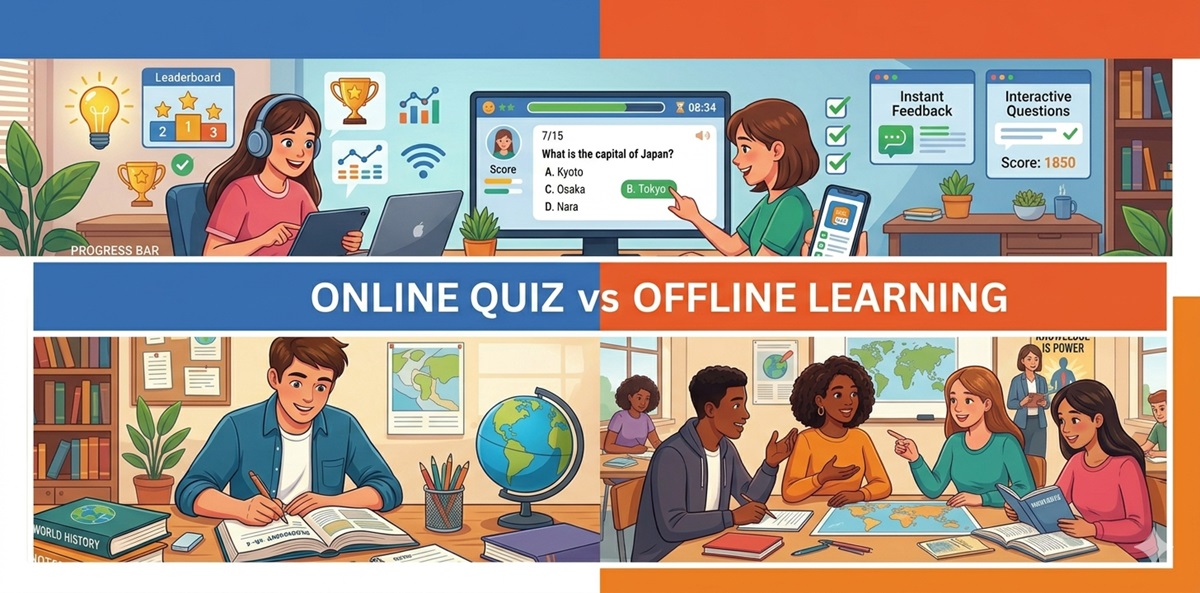
Learning today is very different from earlier times. You don’t have to rely only on classrooms and textbooks anymore. Online quizzes and digital platforms have made learning easier and more flexible. Each way has its own pros and cons, so understanding them can help you choose what suits you best.
What is online quiz-based learning?
Online quiz-based learning is all about simple, interactive tests you can take on your phone or computer. These quizzes are usually short, fun, and give you your score instantly. You’ll find them on apps, websites, and many online learning platforms.
Instead of just reading or watching, this method makes you actively take part. You keep testing what you know, which helps you learn better. Since you get quick results, you can easily spot your mistakes and improve. Practicing again and again also helps you remember things for longer.
Many online quizzes feel like games. They have features like points, rewards, timers, and leaderboards. This makes learning more exciting, especially for young users who enjoy using mobile apps.
What is offline learning?
Offline learning is the traditional way of studying. It includes classroom teaching, textbooks, and learning face-to-face with teachers. This has been the main way of education for many years. In this method, everything is well planned. Students follow a set syllabus, and teachers guide them step by step. Classes, discussions, and written exams are an important part of this system.
Offline learning also builds discipline and a daily routine. It gives a proper environment where students can focus better and understand topics in depth. That’s why many people still prefer it for formal education.
Flexibility and accessibility
Online quizzes are very flexible. You can take them anytime, anywhere. This is great for people who are busy or cannot attend regular classes.
Offline learning is not as flexible. Students have to go to classes at a fixed time and place. If they miss a class, it can break their learning flow. But offline learning has its own advantages. It follows a regular routine, which helps build discipline. This is useful for students who find it hard to manage their time on their own.
Engagement and motivation
Online quizzes are highly engaging. Interactive formats keep users interested. Gamification elements increase motivation and participation.
Short quizzes also reduce cognitive load. Learners can focus better on small chunks of information. This improves overall learning efficiency.
Offline learning can sometimes feel monotonous. Long lectures may reduce attention spans. However, real-time interaction with teachers can boost engagement.
Classroom discussions and group activities create a social learning experience. This aspect is often missing in online quiz formats.
Feedback and performance tracking
One of the biggest advantages of online quizzes is instant feedback. Learners immediately know their scores and mistakes. This helps them to focus on improvements.
Many online platforms also show your progress in a simple way. You can see what you’re good at and where you need to improve. This helps you learn better over time.
In offline learning, feedback usually takes longer. Teachers need time to check exams and give results, which can slow things down.

But offline learning has its own benefits. Teachers can give personal feedback and explain topics clearly, something online quizzes can’t always do.
Depth of learning
Online quizzes are great for practice and revision. They help you remember things by repeating them again and again. But they may not always help you understand topics deeply.
Some subjects need detailed explanations. Offline learning is better for this. Teachers can change their way of teaching based on what students need.
Classrooms also help you think better. Group discussions and debates let you explore topics more deeply. This kind of learning is harder to get from quizzes alone.
Cost and accessibility
Online quiz platforms are often affordable or free. They require only a smartphone or computer and internet access. This makes them accessible to a wider audience.
Offline learning can be expensive. Costs include tuition fees, travel, and study materials. This can be a barrier for many learners.
However, not everyone has reliable internet access. In such cases, offline learning becomes the only viable option.
Discipline and self-learning
Online quiz-based learning requires self-discipline. Learners must manage their time and stay consistent. Without motivation, it is easy to lose focus.
Offline learning provides external discipline. Fixed schedules and teacher supervision keep students accountable. This structure benefits many learners.
At the same time, online quizzes promote independent learning. Users take control of their progress and pace. This builds self-learning habits over time.
Which one should you choose?
There is no one best way to learn. It depends on what you need and what your goals are.
If you like flexible learning and quick practice, online quizzes are a good choice. They are great for revision, exam preparation, and improving skills.
If you want proper guidance and a deeper understanding, offline learning is better. It works well for school, college, and difficult subjects.
The hybrid approach is the future
The most effective strategy combines both methods. Use offline learning for concept clarity and guidance. Use online quizzes for practice and reinforcement.
This mix of both methods gives you the best of both worlds. It helps you remember things better, stay interested, and perform well.
In today’s fast-moving world, learning should be smart and flexible. Using online quizzes along with offline learning can create a strong system that helps you get better results.
Conclusion
In the end, you don’t have to pick just one way of learning. The best approach is to use both together. Offline learning helps you understand concepts and stay disciplined, while online quizzes help you practice, improve speed, and remember things better. Together, they make learning easier and more effective.
If you want to make learning more fun, you can try platforms like Qureka Gamez. It offers simple and engaging quizzes, live challenges, and rewards, making learning feel like a game that you’ll enjoy doing every day.